Visar inlägg som sorterats efter relevans för sökningen terrorism. Sortera efter datum Visa alla inlägg

måndag, maj 11, 2009

EUROPOL om islamistiska terrorister

EUROPOL publicerar sin årliga sammanställning
över terrorismen i Europa. Bland nyheterna kan
konstateras att islamismen fått ett eget kapitel.....
**
**
En kort sammanfattning:

■ In 2008 one bomb attack with Islamist
terrorist background took place in the UK.
■ Arrests made in Spain, Belgium, France
and other countries were related to attack
planning activities. These plans indicate
that Islamist terrorists aim at causing
indiscriminate mass casualties.
■ A number of member states judge that
they continue to face a high-level threat
from Islamist terrorism for reasons that
include military presence in Iraq or
Afghanistan or accusations of anti-Muslim
attitudes.
■ In 2008, 187 people were arrested on
suspicion of Islamist terrorism. The majority
of arrests took place in France and Spain.
Arrested suspects had a variety of
backgrounds, including North African,
South Asian, Turkish and also European.
■ ‘Home-grown’ terrorism is a cause of
concern. A majority of the arrested
individuals belonged to small autonomous
cells rather than to known terrorist
organisations.
■ Islamist recruitment activities have largely
been driven underground. Radicalisation
activities are noted to have moved from
mosques and other public places into
private spaces. Prisons and the Internet
continue to be locations of concern
regarding this phenomenon.
■ Afghanistan and Pakistan seem to have
replaced Iraq as preferred destinations
for volunteers wishing to engage in armed
conflict.
***

Of the 1009 persons that, according to information
from the member states, were arrested in
the EU in 2008 on suspicion of involvement in
terrorism, 187 were arrested in relation to
Islamist terrorism. This is a decrease of 7 percent
as compared to 2007, following an earlier
decrease of 21 percent from 2006 (257) to 2007
(201).
The majority of the arrests took place
again in France and Spain, with 78 and 61
arrests, respectively.
**
The number of member states which reported
arrests related to Islamist terrorism decreased
from 14 in 2007 to ten in 2008. These were
Belgium, Denmark, France, Germany, the
Republic of Ireland, Italy, the Netherlands,
Slovakia, Spain and Sweden.
**
As in 2006 and 2007, the majority of the arrested
suspects came from North African countries,
most notably Algeria, Morocco and Tunisia,
although the share of Moroccan and Tunisian
citizens in the numbers of arrests halved as
compared to 2007. Like for 2007, France
reported a high number of arrests of French
nationals in 2008. Other suspects apprehended
in France in 2008 originated from various EU
member states (55 percent), including Belgium,
Germany, Spain and the Netherlands, and outside
the EU (37 percent), such as Pakistan, Afghanistan
and Turkey.
****
Terrorism Monitor kommenterar:
The Belgian cell illustrates another major problem,
which is the connection between the Afghanistan-
Pakistan region and the terrorist threat in Europe.
Indeed, as the report states, “Afghanistan and Pakistan
seem to have replaced Iraq as preferred destinations
for volunteers wishing to engage in armed conflicts.”
These recruits pose a threat to European troops
deployed in Afghanistan. Germany, for instance,
is particularly worried about the presence of several
of its citizens (most notably Eric Breininger) in
the region who are allegedly plotting operations
against German troops
(see Terrorism Focus, January 28).
**
When fighters return – such as members of
the Belgian cell, or members of the Sauerland cell
in Germany – they pose a direct threat to European
security. As expressed by U.S. Director of National
Intelligence, Dennis Blair, “the primary threat from
Europe-based extremists stems from al-Qaeda and
Sunni affiliates who return from training in Pakistan
to conduct attacks in Europe or the United States.”

torsdag, januari 26, 2017

"Defending the civilized world"


Clifford D. May is president of the Foundation for Defense of
Democracies and a columnist for The Washington Times
 
***
In an inaugural address that was more purposeful than poetic, President Trump last Friday vowed to “unite the civilized world against radical Islamic terrorism, which we will eradicate from the face of the Earth.”
I hope we can agree, across party and ideological lines, that those are worthwhile objectives. But let’s acknowledge, too, that achieving them will require a much more strenuous and strategic effort than previous administrations have undertaken.

The least likely place for uniting nations: the United Nations, an organization that has never managed even to define terrorism. A few U.N. members fight terrorism day after day (e.g., Egypt, Jordan, Israel). Others, however, condone and even sponsor it (e.g., Iran). The U.N. includes representatives of both the civilized and uncivilized worlds, and cannot be said to prefer one over the other.
Our Europeans allies are civilized — perhaps to a fault. Many embrace moral relativism as expressed in the mantra: “One man’s terrorist is another man’s freedom fighter.” Bringing Europe into a meaningful union against terrorism will require a heavy lift.

A straightforward definition of terrorism: violence intentionally directed against noncombatants for political purposes. That should, indeed, be seen as a barbaric practice. But terrorism is not the enemy. It is only a weapon the enemy deploys.
Most contemporary terrorism is, as Mr. Trump suggested, driven by “radical Islam,” an adequate term for a variety of ideologies rooted in totalitarian, supremacist and medievalist readings of Islamic scripture. Those who understand this also grasp why the Islamic State and the Islamic Republic of Iran are more alike than different.

Not for the first time is America threatened by such totalitarian foes. The goal of the Communists was domination by one class. The Nazis sought to establish the supremacy of one race. Today, the Islamists fight for one religion über alles. They want all of us, Muslim and “infidel” alike, to obey Shariah — Islamic law as they interpret it. And if you don’t think they’ve been making progress over recent years you haven’t been paying close attention.

To defeat the Nazis and their allies required battles on many fronts from North Africa to the South Pacific. World War II, though relatively brief, was exceedingly lethal: More than 60 million people killed, about 3 percent of the world’s population at the time.

The Cold War followed. In 1946, diplomat George Kennan sent his “Long Telegram” from Moscow analyzing Joseph Stalin’s ideology and intentions. Largely on this basis, President Truman, in 1947, decided to “contain” the Soviet Union and assist those threatened by communist aggression.
Three years after that, as military strategist Sebastian Gorka recalls in his 2016 book, “Defeating Jihad,” a State-Defense Policy Review Group was established under the chairmanship of Paul Nitze, then director of policy planning in the State Department. It produced NSC-68, a 58-page National Security Council report on the USSR, its “fanatic faith” and its determination to “impose its absolute authority over the rest of the world.”

NSC-68 explained why the Soviets were unlikely to sincerely embrace peaceful coexistence: “The United States, as the principal center of power in the non-Soviet world and the bulwark of opposition to Soviet expansion, is the principal enemy whose integrity and vitality must be subverted or destroyed by one means or another if the Kremlin is to achieve its fundamental design.” On this basis, Truman implemented a robust set of policies, including covert actions and psychological warfare, aimed at weakening the Kremlin and frustrating its imperialist designs.

Fast forward to 1983, when President Ronald Reagan came to the conclusion that containment had proven insufficient and attempts at detente unavailing. He accused his predecessor, President Jimmy Carter, of “vacillation, appeasement and aimlessness.”

It is sometimes said that Reagan’s strategy was “We win, they lose.” In fact, that was his desired outcome. The essence of his strategy was articulated in National Security Decision Directive 75. “NSDD-75 was an extraordinarily ambitious, across-the-board assault on the Soviet Union,” in the words of Paul Kengor, author of “The Crusader: Ronald Reagan and the Fall of Communism.”
To the disapproval of many academics and State Department officials, Mr. Reagan would call the Soviet Union an “evil empire” and exert pressure — diplomatic, political, military, ideological and, not least, economic — on a regime that was not as strong or stable as it looked to most observers, the CIA included.

On Dec. 25, 1991, three years after Reagan left office, the hammer-and-sickle flag that had flown over Moscow since early in the 20th century would be lowered for the final time.

In retrospect, it may appear that the defeat of communism was inevitable. More plausibly, it was the result of Reagan’s revival of national strength and purpose — combined with solid research, analysis and, above all, strategic planning.
Many Americans and Europeans disapproved of the project. They believed the Soviets had a thing or two to teach us about social justice and they looked forward to communism and capitalism “converging.” Such people are with us still.

“The future is unknowable,” Churchill recognized, “but the past should give us hope.” Islamic radicalism and the terrorism it inspires can be defeated — though eradication, at least in the near-term, may be too ambitious a goal. We should not imagine that the process will be quick or easy.

A global revolution is underway. It threatens free nations. It is led by true believers — Sunni and Shia alike — who nurture ancient resentments and exhibit a formidable “will to power.” They have a strategy and they are prepared to fight a long war. Not until the same can be said of us will it be possible to defeat them.


lördag, augusti 07, 2010

Terrorismen i Sverige - ur amerikanskt perspektiv

Amerikanska State Department offentliggör varje år
s k Country Reports on Terrorism. Idag kom 2009 års rapport.
Här har ni avsnittet Sweden

The Swedish Security Service (SAPO), which has responsibility for counterterrorism, distinguished between attack and activity threats in its terrorism assessment. Attack threats, which included plans to carry out attacks in Sweden and/or against Swedish interests abroad, remained low. SAPO noted, however, an increased activity threat from individuals who were planning, supporting, or financing terrorist attacks in areas of conflict. A number of individuals with connections to radical and violent networks, primarily al-Qa’ida (AQ) and al-Shabaab, continued to depart Sweden for training camps in Afghanistan, Pakistan, Somalia, and Iraq. According to estimates, the number of persons who seek ideological education, weapons training, or other activity in training camps abroad is likely to increase, and these individuals have the potential to speed up radicalization in Sweden. SAPO is responsible for trying to prevent such trips, but existing legislation leaves few possibilities to stop determined individuals from leaving Sweden. SAPO, therefore, continued to work to identify individuals planning to travel to training camps and held dialogues with them to try to prevent their travel, and it also spoke with persons who were suspected of returning from such travel. At least 20 Swedes were estimated to be active in camps around the world. Somalia continued to be the destination that attracted most individuals, and SAPO confirmed that it was aware of a hand-full of casualties involving ethnic Somali Swedish citizens fighting in East Africa.

In July, Xasaan Xussen, a spiritual leader for the Somali terrorist organization al-Shabaab, spoke at a conference in the Bellevue Mosque in Gothenburg. Xuseen’s visit was controversial because of a widespread concern that he came to Sweden to recruit young people and collect money for al-Shabaab. On July 15, the Somali Minister of Justice Abdirahman Janaqoo visited Sweden to discuss how to prevent young Somali-Swedes from traveling to Somalia and fight against the government. Together with two Somali parliamentarians, Minister Janaqoo met with representatives from the Swedish government to discuss radicalization of Somali-Swedes. In November, the media reported that a Swedish-Somali youth leader had used a youth center in one of Stockholm’s suburbs as a base for al-Shabaab recruitment.

Swedish authorities monitored individuals with connections to AQ, al-Shabaab, Ansar al-Islam, the Revolutionary Armed Forces of Colombia, Hizb Al-Tahrir, Hizballah, Islamic Jihad, and the Kurdistan Workers’ Party (PKK). According to Swedish terrorism experts, members of terrorist groups, such as Ansar al-Islam, and Hizballah, used funds earned in Sweden to finance terrorist activities elsewhere. The al-Aqsa Foundation in Malmo was shut down in 2007 when it was suspected of financing HAMAS. Its chairman, Khaled al-Yousef, went on trial for terrorist financing and violating international sanctions, though he was acquitted in November after the case had been reviewed in two different courts.

Swedish law does not provide the government with independent national authority to freeze or seize assets, unless in connection with an ongoing criminal investigation. However, once the EU takes action, the government can and does freeze assets of entities and persons listed on the UN 1267 Sanctions Committee list. This procedure is managed through the Sanctions Act (1995). On October 26, the Swedish branch of the Somali bank network Al-Barakaat was delisted from the UN’s sanctions list. The Swedish branch of the organization was first designated in 2001 and about US$ 142,857 of frozen assets will now become accessible. Sweden can also take action against entities designated by the EU clearinghouse process, although Sweden has not yet proposed individuals or entities for inclusion on such lists.

On March 15, a new law on money laundering and terrorist finance came into effect that covers a broader range of entities and requires companies to have better knowledge about customer transactions. Suspicious transactions have to be reported to the Financial Police for further investigation. A special unit at the Financial Supervisory Authority, which supervises and monitors companies operating on the financial market, has been established to oversee implementation of the new legislation.

In late 2008, the Swedish Parliament approved the new EU directive on counterterrorism, which was intended to harmonize the EU Member States’ domestic laws and to criminalize public exhortation to terrorist crimes, recruitment and training for terrorism purposes, including actions performed over the Internet. In order for Sweden to comply with the directive, changes in the current legislation and a new law have been drafted. On December 21, the government introduced its proposed bill for action by the Parliament for voting.

Between July 2008 and June 2009, Sweden applied its Special Alien’s Control Act once. The act was established in 1991 to prevent presumptive terrorists from entering or residing in Sweden but also permits for control of individuals, who due to asylum reasons still have to be granted a stay in Sweden. In this particular case, the government decided to deport the person from Sweden.

While there were no convictions for terrorism in Sweden during the reporting period, the following cases should be mentioned:

  • In April, a 32 year-old Swedish citizen of Somali origin was arrested in the United Kingdom, where he currently faces allegations for terrorist financing in Somalia.
  • In July, Swedish citizen Misrad Bektasevic, who was convicted on terrorism charges in Bosnia in 2005, was transferred from Bosnia to Sweden, where he will serve the remainder of his prison sentence. Bektasevic was arrested by Bosnian Security Police in Sarajevo, when he was found in an apartment with explosives, weapons, and suicide bomb belts in 2005. A video with masked persons threatening to attack forces in Iraq and Afghanistan was found and a voice analysis proved that Bektasevic was one of the individuals in the video. In 2007, he was sentenced to eight years and four months imprisonment for terrorism-related crimes.

During Sweden’s EU Presidency in the latter half of the year, Sweden arranged a conference on prison radicalization and prevention; a seminar on enabling local police officers to detect and prevent radicalization; chaired the Working Party meeting on Terrorism and Terrorist Financing between the EU and the United States; and led EU efforts for negotiating the interim Terrorist Financing Tracking Program Agreement between the EU and the United States. Sweden also drafted and negotiated the EU’s new five-year program within Justice and Home Affairs, which involves counterterrorism and law enforcement cooperation. Sweden continued to contribute to counterterrorism capacity-building projects in third countries.

In November, the Swedish Parliament voted to extend the mandate for its troop contribution to the International Security Assistance Force in Afghanistan for another 12 months. Troop numbers are expected to remain at 500 and Sweden will continue its engagement in northern Afghanistan.

tisdag, juli 04, 2017

Vad Europa kan lära av Israel


Terrordåden i Europa duggar tätt.
Paris, Bryssel, London, Stockholm, Berlin....
Listan kan tyvärr göras lång och växer ständigt.
 
Gårdagens "avslöjande" av SÄPO att det finns över 2.000
"våldsbenägna islamister" i Sverige (och i praktiken inga
motåtgärder) borde få svenska folket att sova lite sämre....
 
Men nu utkommer en rapport som kan hjälpa de
europeiska myndigheterna. Det enda lyckade exemplet
på terrorbekämpning: Israels erfarenheter av årtiondens
kamp mot den islamistiska terrorismen. Den italienska
författaren och tidigare parlamentsledamoten Fiamma
Nirenstein har sammanställt en liten skrift till vår hjälp.
Läs och sprid !


Hon presenterar själv rapporten så här:

London, Paris, Berlin, Brussels, Tel Aviv and Jerusalem. Europe and Israel continue to be assaulted by radical Islamic terror. The terrorist Jihadists have declared that Europeans and Israelis are infidels to be destroyed and conquered.

The small state of Israel always fought back against terrorism. Since the beginning of its history, the Jewish State has been forced to defend against terror every day of every year.

I have been for 5 years in the Italian Parliament. As the deputy president of the commission of foreign affairs we have been discussing so many times the question of terrorism. And it was astonishing how difficult it is for the Europeans even to define the issue of terrorism.

They asked me how does Israel fight as a democracy so well against terror? and this is what we are trying to do here, to give answers.

Israel has developed strategies to maximize national resilience and maintain public morale in the face of unrelenting terror attacks. Israel has also embraced the highest moral standards possible in combatting terror, protecting civil and human rights, as well as protecting privacy while deterring and preventing future attacks.

The Jerusalem center recent study reveals what Israel has been doing to fight terrorism since its very beginning.

So here you have a book with 9 essays about strategies, about the resilience of people, about international law, about cyber-terrorism. Whatever you want to know about the fight again terrorism. This is what we are offering to our friends in Europe.

By developing a shared strategy, we can win the war on terror. In London, Paris, Berlin and Jerusalem
.

* * *

Fiamma Nirenstein served as a member of the Italian Parliament (2008-2013) where she was Vice President of the Committee on Foreign Affairs in the Chamber of Deputies. During her mandate, she established and chaired the Parliamentary Committee for the Inquiry into Anti-Semitism, as well as the Institutional Cooperation Committee between the Knesset and the Chamber of Deputies. A journalist and author, Ms. Nirenstein is a founding member of the International Friends of Israel Initiative and a fellow of the Jerusalem Center for Public Affairs. She is the author of eleven books, among them “Israel Is Us” (2009) whose English version was published by the Jerusalem Center.


torsdag, april 28, 2016

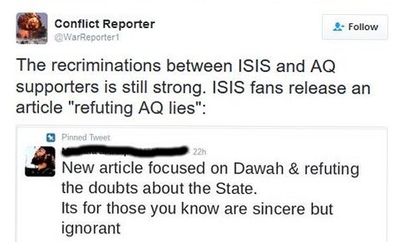
Kalifatet och Al Qaeda tävlar i terrorism


Al Qaeda får inte så mycket publicitet för tillfället,
men är på intet sätt utslaget. Snarare ökar hela
tiden risken för att de två ledande islamistiska
terrororganisationerna Kalifatet och Al Qaeda
försöker tävla om makt och inflytande genom
ännu mera spektakulära terrordåd...
Den ofta välunderrättade holländska
underrättelsetjänsten AIVD varnar för
nya "Mumbaidåd" i Europa som led i
den kampen om anhängare, skriver
IPT News: 

** 

tisdag, oktober 10, 2017

Islamism och kriminalitet i nära förening....


De minnesgoda minns säkert terrormorden i Köpenhamn 2015.
Gärningsmannen Omar al-Hussseini var precis släppt efter
två års fängelse för grov missshandel. Medlem i ett shariagäng,
knarklangare, rånare, islamist etc
 
Det är en bakgrund som snarast är "det normala" för
dagens jihadistiska terrorister. Frontpage Magazine
har undersökt ett antal av de senaste årens terrorister
och konstaterar ett klart mönster:
There exists a symbiotic relationship between Islamic
terrorism and non-ideologically driven criminality.
For the hard core or petty criminal, Islam represents
a pathway for redemption.
The terrorism component enables the assailant to
 continue his violent or deceitful activities while
claiming that these activities are being performed
in the name of Allah. Some violent recidivists are
simply drawn to the cruel and sadistic aspects
of radical Islam.
 
Något som inte särskilt nämns i artikeln är kopplingen
salafistmoské-jihadister. Inte minst Malmö, som ju precis
i stadens kriminella träsk borde fundera över detta
klara samband...
 
 
***
On October 1, a Muslim man of North African descent in his 30s arrived at Saint-Charles station in Marseille with one purpose in mind – to murder as many people as possible in the name of Islam. His first victim, a 20-year-old medical student from Marseille never stood a chance. The assailant lunged at her with a knife whose blade measured 8 inches, and stabbed her repeatedly while screaming “Allah Akbar.” He fled the scene but returned shortly thereafter to claim his second victim, a 21-year-old trainee nurse from Lyon. According to sources, one of the victims also had her throat slit.

The cold-blooded and depraved murder of the two young women failed to satiate terrorist’s lust for blood. After murdering his second victim, he ran toward soldiers patrolling as part of Operation Sentinelle, who shot him dead. In Western Europe, this is the new normal but the situation is particularly acute in France, which has experienced a rolling wave of terrorism since 2012. The country currently resembles an armed camp with the deployment of thousands of soldiers and police armed with automatic weapons, patrolling sensitive locations. But apart from increased security, France appears unable or unwilling to do more to counter the threat.

The Marseille slaughter could have easily been prevented but French authorities imbibed with a combination of political correctness, laziness and just plain stupidity, allowed it to occur. The terrorist who committed the gruesome attack was known to law enforcement. He was a recidivist whose rap sheet included a laundry list of petty crimes. In fact, just days before the attack, he was arrested for shoplifting but inexplicably released despite the fact that he possessed at least seven fake identities. The man, who informed the police that he was homeless, had given them a Tunisian passport in the name of Ahmed H, born on November 9, 1987 at Bizerte. But a quick fingerprint check would have revealed that he was lying through his teeth. Unfortunately, the fingerprint verification was performed after the Marseille slaughter.

French law enforcement officials attempted to deflect responsibility by claiming that the man had no known terrorist ties and that shoplifting offenses generally result in a police report and a court summons to appear at a later date. The proffered excuse is disingenuous at best. For years, French law enforcement officials have been cognizant of the nexus between criminal activity and radical Islamic terrorism. Several well-researched and detailed studies have confirmed this interconnection. In fact, as many as 80% of those who have committed terrorist attacks in the UK, France, Belgium, Germany and elsewhere in Western Europe in the name of Islam have criminal records with lengthy rap sheets that include drug dealing, petty larceny, assault and identity theft.

As noted, the terrorist who committed the Marseille outrage was a serial shoplifter and an identity thief. Khalid Masood, the UK terrorist who carried out the Westminster car-knife attack in March had a number of convictions for causing Grievous Bodily Harm (GBH) possession of offensive weapons and public order offenses. Kobili Traore, the Muslim man who brutally beat elderly Jewish pensioner Sarah Halimi, while yelling Islamic and anti-Semitic slogans, and then proceeded to throw her out of a third-floor window to her death had spent several years in prison for acts of aggravated violence and drug dealing. Amedy Coulibaly, the terrorist who stormed the Hypercacher kosher supermarket in Paris killing four, had previously been jailed for dealing in stolen goods, drug trafficking and robbery. Brothers Ibrahim and Salah Abdeslam, who were part of the gang that perpetrated the deadly Paris attacks in November 2015, were drug users and traffickers. The bar the duo owned in Molenbeek, a district of Brussels, was shut down by police for being a drug den.

The list is endless. There exists a symbiotic relationship between Islamic terrorism and non-ideologically driven criminality. For the hard core or petty criminal, Islam represents a pathway for redemption. The terrorism component enables the assailant to continue his violent or deceitful activities while claiming that these activities are being performed in the name of Allah. Some violent recidivists are simply drawn to the cruel and sadistic aspects of radical Islam.

Islamic terrorists frequently recruit from the rather large pool of criminals who domicile in Western countries but feel no loyalty to their host countries, despite the fact that these liberal democracies often provide them with outrageous entitlements including subsidized housing and stipends. The Islamist recruiter offers the criminal a pathway for redemption through religion but at the same time, takes advantage of the skills offered by the criminal to implement the terrorist scheme. For example, a drug dealer can use proceeds to finance a terror operation while an identity thief has the know-how to either forge or illegally obtain identity papers. The violent felon is often knowledgeable in the use of firearms or has the necessary connections to obtain illegal firearms and explosives. 


måndag, maj 04, 2009

Sverige rapporterar....

US State Departement publicerar som vanligt
den årliga
Den svenska delen brukar innehålla lite mer
Om ni studsar inför en del besynnerliga på-
ståenden, som t ex The Government of Sweden
did not provide safe haven to terrorists or terrorist
organizations, så beror det på att det är svenska
myndigheter som skriver den svenska delen.....
Därför, varsågoda:
***
"Sweden
The Government of Sweden placed a high priority on
increasing international cooperation against terrorism.
Swedish authorities considered the threat of terrorist
attacks inside Sweden to be low, but they monitored a
number of known terrorists and terrorist organizations
within their borders, including al-Qa‘ida (AQ), Al-Shabaab,
Ansar al-Islam/Sunna, the Revolutionary Armed Forces
of Colombia (FARC), Hizb Al-Tahrir, Hizballah, Islamic
Jihad, and the Kurdistan Workers‘ Party (PKK).
These groups provided logistical and financial support
to their respective organizations abroad.
*
The Government of Sweden did not provide safe haven
to terrorists or terrorist organizations. Terrorist organizations
exploited Sweden's considerable legal protections of personal
freedoms and civil liberties to maintain a presence in the country,
however. Sweden‘s political asylum policy attracted individuals
from areas of conflict. According to Swedish terrorism experts,
members of terrorist groups, such as Ansar al-Islam, Ansar al-
Sunna, and Hizballah, used funds earned in Sweden to finance
terrorist activities elsewhere. In 2007, the Swedish government
shut down the al-Aqsa Foundation in Malmo when it was
suspected of facilitating such activity for Hizballah.
On December 22, its deputy chairman, Khaled al-Yousef, was
charged with financing terrorism in Israel; he has not been
sentenced. Swedish law does not provide the government
independent national authority to freeze or seize assets,
unless in connection with an ongoing criminal investigation.
However, once the EU takes action, the government can
and does freeze assets of entities and persons listed on
the UN 1267 Sanctions Committee list. This procedure is
managed through the Sanctions Act (1995). Sweden can
also take action against entities designated by the EU
clearinghouse process, although Sweden has not yet
proposed individuals or entities for inclusion on such lists.
Sweden played an active role in EU deliberations to develop
legal instruments for the listing and de-listing of terrorist
organizations and an appeals process after the freezing of
financial assets. Without a designation by the UN or EU,
Swedish authorities only have the right to seize assets
once a criminal investigation has been initiated. Efforts
to create a national authority and address existing short-
comings are underway. Terrorism-related cases in
Sweden included:
*
On May 8, Ahmad Hamad, a Swedish resident born in Iraq,
was arrested and placed in detention by U.S. forces in Iraq.
Hamad remained in detention.
*
In the spring, three Swedish residents of Somali origin
were released from prison after being held for three
months on suspicion of funneling funds to terrorist
organizations in Somalia. (Three others were arrested
in Norway.)
*
On October 5, Abu Qaswarah, a Swedish citizen, died
in a firefight with Iraqi and U.S. forces in Iraq. He
allegedly was the second in command of AQ and
was the senior leader of AQ in northern Iraq. A
Moroccan native, Qaswarah had historic ties to AQ
in Iraq founder Abu Musab al-Zarqawi and senior
AQ leaders in Afghanistan and Pakistan. According
to the Swedish Security Service, Qaswarah was known
for his activities in violent Islamist circles in Sweden
and was listed on the UN and EU terrorist lists in
December 2006.
*
In 2005, the Swedish Court of Appeal found Ali
Berzengi and Ferman Abdullah, Iraqi citizens with
Swedish residency permits, guilty of financially
supporting Ansar al-Sunna terrorist actions in Irbil,
Iraq. They remained in custody awaiting a government
decision on deportation.
*
On August 4, a Moroccan, Abderazzak Jabri, was
extradited from Sweden to Morocco. He first arrived in
Sweden via Spain in 2002 and applied for asylum. He
moved into the mosque in Brandbergen, where he
shared rooms with Abu Qaswarah (see above).
The mosque was under surveillance by Swedish authorities,
who in March 2004 arrested several suspects, including
Jabri. Afterwards Jabri was seen as a ―security threat,"
resulting in the rejection of his asylum case. Jabri
disappeared but turned up in Vienna two years later (2006)
with a fake passport and tickets to Syria. Jabri claimed he
was on his way to Spain to apply for amnesty as an illegal
immigrant. He was then held by Swedish authorities until
his extradition to Morocco in August 2008.
*
The Swedish government also agreed to pay damages to two
Egyptian nationals, Ahmed Agiza and Muhammed Alzery/
al-Zari. The men claimed they had been deported by Sweden
to Egypt, where they had been tortured. An asylum request
to return to Sweden was subsequently denied by Swedish
authorities; both men have appealed and remained in Egypt,
where Agiza is incarcerated.
*
Through the European Common Foreign and Security Policy,
Sweden continued to contribute to capacity-building projects
in Morocco, Algeria, and Indonesia.
Sweden participated in EUROPOL and EUROJUST, European l
aw enforcement institutions that coordinated member states‘
counterterrorism cooperation and activities. Additionally,
it participated in the Nordic Council of Ministers Regional
Forum for Nordic Governmental Cooperation.
Sweden contributed over USD 1,000,000 to the Terrorism
Prevention Branch of the UN Office on Drugs and Crime.
In December, Sweden's Parliament voted to raise its troop
contribution to the International Security Assistance Force
in Afghanistan from 350 to 500. As a country participating
in the Visa Waiver Program (VWP), Sweden continued to
comply with requirements in the VWP law related to
information sharing and other law enforcement and
counterterrorism cooperation. This cooperation was further
enhanced by the Implementing Recommendations of the
9/11 Commission Act of 2007. "
***
Min kommentar:
Som Jihads läsare väl vet är terroristen
Abu Qaswarah en ren fiktion. Mannen
hette Mohamed Mommou....

fredag, november 27, 2009

Islamism 2.0 - nu ännu farligare


Daniel Pipes hade ett varningsord till
Västerlandet i onsdagens Jerusalem Post:

To borrow a computer term, if Ayatollah Khomeini, Osama bin Laden, and Nidal Hasan represent Islamism 1.0, Recep Tayyip Erdoğan (the prime minister of Turkey), Tariq Ramadan (a Swiss intellectual), and Keith Ellison (a U.S. congressman) represent Islamism 2.0. The former kill more people but the latter pose a greater threat to Western civilization.

Hussam Ayloush hosted Congressman Keith Ellison (D-Minn) at a CAIR event in November 2007.The 1.0 version attacks those perceived as obstructing its goal of a society ruled by a global caliphate and totally regulated by the Shari'a (Islamic law). Islamism's original tactics, from totalitarian rule to
mega-terrorism, encompass unlimited brutality. Three thousand dead in one attack? Bin Laden's search for atomic weaponry suggests the murderous toll could be a hundred or even a thousand times larger.
However, a review of the past three decades, since Islamism became a significant political force, finds that violence alone rarely works. Survivors of terrorism rarely capitulate to radical Islam – not after the assassination of Anwar el-Sadat in Egypt in 1981, nor the 9/11 attacks, the Bali bombings of 2002, the
Madrid bombing of 2004, the Amman bombing of 2005, or the terrorist campaigns in Israel, Iraq, Afghanistan, and Pakistan. Terrorism does physical damage and kills and intimidates but it rarely overturns the existing order. Imagine Islamists had caused the devastation of Hurricane Katrina or the 2004 tsunami – what could these have lastingly achieved?
Non-terrorist violence aimed at applying the Shari'a does hardly better. Revolution (meaning, a wide-scale social revolt) took Islamists to power in just one place at one time - Iran in 1978–79. Likewise, coup d'état (a military overthrow) carried them to power just once – Sudan in 1989. Same for civil war – Afghanistan in 1996.
If the violence of Islamism 1.0 rarely succeeds in forwarding the Shari'a, the Islamism 2.0 strategy of working through the system does better. Islamists, adept at winning public opinion, represent the main opposition force in Muslim-majority countries such as Morocco, Egypt, Lebanon, and Kuwait. Islamists have enjoyed electoral success in Algeria in 1992, Bangladesh in 2001, Turkey in 2002, and Iraq in 2005.
Once in power, they can move the country toward Shari'a. As Mahmoud Ahmadinejad faces the wrath of Iranian street demonstrators and bin Laden cowers in a cave, Erdoğan basks in public approval, remakes the Republic of Turkey, and offers an enticing model for Islamists worldwide.
Sayyid Imam al-Sharif, the Egyptian theorist of Al-Qaeda, changed his approach and now endorses lawful Islamism.Recognizing this pattern, Al-Qaeda's once-leading theorist has publicly repudiated terrorism and adopted political means. Sayyid Imam al-Sharif (b. 1950, also known by the nom de guerre Dr. Fadl) was accused of helping assassinate Sadat. In 1988 he published a book that argued for perpetual, violent jihad against the West. With time, however, Sharif observed the inutility of violent attacks and instead advocated a strategy of infiltrating the state and influencing society.
In a recent book, he condemned the use of force
against Muslims ("Every drop of blood that was shed or is being shed in Afghanistan and Iraq is the responsibility of bin Laden and Zawahiri and their followers") and even against non-Muslims (9/11 was counterproductive, for "what good is it if you destroy one of your enemy's buildings, and he destroys one of your countries? What good is it if you kill one of his people, and he kills a thousand of yours?").
Sharif's evolution from theorist of terrorism to advocate of lawful transformation echoes a much broader shift; accordingly, as author
Lawrence Wright notes, his defection poses a "terrible threat" to Al-Qaeda. Other once-violent Islamist organizations in Algeria, Egypt, and Syria have recognized the potential of lawful Islamism and largely renounced violence. One also sees a parallel shift in Western countries; Ramadan and Ellison represent a burgeoning trend.
(What one might call Islamism 1.5 – a combination of hard and soft means, of external and internal approaches – also works. It involves lawful Islamists softening up the enemy, then violent elements seizing power. The Hamas takeover of Gaza proved that such a combination can work: win elections in 2006, then stage a violent insurrection in 2007. Similar processes are possibly underway in
Pakistan. The United Kingdom might be undergoing the opposite process, whereby violence creates a political opening.)
In conclusion, only Islamists, not fascists or communists, have gone well beyond crude force to win public support and develop a 2.0 version. Because this aspect of Islamism undermines traditional values and destroys freedoms, it may threaten civilized life even more than does 1.0's brutality.

lördag, augusti 21, 2021

MI5 varnar för terrorvår


Alltfler experter från europeiska säkerhetstjänster varnar för att Europa och USA kan förvänta sig en "het" terrorvår 

Taliban-Afghanistan kommer att erbjuda alla islamistiska terrorister en trygg bas och obegränsat med resurser.

Igår kom en varning från f d chefen från MI5, brittiska säkerhetstjänsten, en tung och mycket erfaren röst i branschen.

****

Ex-MI5 chief warns of 'increased threat' after Afghan collapse with Qaida getting 'operating space' and 'psychological' boost for terrorists - as he says West was 'too ambitious' trying to build new country

  • Former MI5 chief says Afghan chaos will mean an 'increased threat' from terror
  • Fallout from the collapse of the Afghanistan government after US troops pullout
  • Ben Wallace has warned the perceived 'victory' by Taliban will inspire terrorism

The West faces an 'increased threat' after the collapse of Afghanistan, the former head of MI5 warned today.

Lord Jonathan Evans said the success of the Taliban will give al Qaida 'more operating space' and a 'psychological' boost for other terrorists.

He also criticised the 'overambitious' goals of the Afghanistan campaign, saying the 'significant failure' might have been avoided if the focus was on keeping extremism in check. 

The stark assessment came as the UK and US scramble to evacuate citizens and local allies from Kabul, with a blame game in full swing over the humiliating outcome.

Lord Evans told BBC Radio 4's Today programme: 'I think there are two problems – I think there is more operating space more likely to be available to groups like al Qaida, and there have been reports of Islamic State elements present in Afghanistan.

'If they get the opportunity to put down infrastructure to train and to operate then that will pose a threat to the West more widely.

'There's also the psychological effect of the inspiration that some people will draw from the failure of Western power in Afghanistan.

'That may well create a certain amount of energy in the wider networks that are still in existence in Britain and across the West.

'So, I think, in practical terms and in terms of ungoverned space, but also in psychological terms, it probably does mean an increase in threat over the coming months and years.'

Lord Jonathan Evans said the success of the Taliban will give al Qaida 'more operating space' and a 'psychological' boost for other terrorists

Lord Jonathan Evans said the success of the Taliban will give al Qaida 'more operating space' and a 'psychological' boost for other terrorists

The peer said the West had been 'overambitious' in trying to rebuild Afghanistan rather than focusing on quelling the terror threat. 

He told BBC Radio 4's Today programme: 'My own personal view is that we should have focused very narrowly on counter-terrorism objectives in regard to Afghanistan.

'I think it was very worthy and rather ambitious to think we could reshape the whole country, whereas the reason we went in originally was for counter-terrorism reasons, and I think that might have been a more achievable task.'

Lord Evans said the 'capability and perseverance' needed to try and rebuild the nation was 'beyond us' due to either political or resource reasons.

He added: 'It might have been the case that the Taliban were in power, it might have been possible to have maintained a smaller level of merely counter-terrorism capability in the region so that we had the capacity to intervene.

'I think right from the beginning there was a noble ambition that we would have been able to reshape the politics of that region and I think, in retrospect, that was overambitious.

'It would have been a great thing to have achieved but we raised expectations that we were not able to follow through on and the overall effect of that has been a significant failure and setback for us.'

Theresa May was among the senior MPs warning during a Commons debate this week that Afghanistan could again become a 'breeding ground for terrorism' - the reason for the original invasion in 2001. 

Yesterday Ben Wallace gave a similar warnings, saying the meltdown will 'inspire' terrorists and be an 'opportunity' for al Qaida.

The Defence Secretary said the Taliban taking power will be seen as a 'victory' by extremists around the world.

And he cautioned that the West will now have to 'tool up' to counter a potential resurgence from the group founded by Osama bin Laden. 

Ben Wallace said yesterday that the Taliban taking power will be seen as a 'victory' by extremists around the world

'Around the world Islamists will see what they will view as a victory. That will inspire other terrorists,' Mr Wallace told BBC Radio 4's Today programme. 

Mr Wallace said 'cyber geography' was now more important that territory, as extremists organise online. He also insisted he hoped that the Taliban would be unwilling to host terrorist groups as they try to rebuild links with the rest of the world.

But he said: 'I don't think anyone's denied that al Qaida is potentially going to look on this as an opportunity.

'We will have to, obviously, gear up, tool up; we already have capabilities to deal with some of that.'

Thousands of British nationals and Afghan allies have been trying to get out of the country after the government dramatically collapsed and the Taliban took charge.

There have been grim scenes of women pleading to be let through the gates at the airport, and even reports of babies being passed over the railings by mothers. 

UK ambassador Laurie Bristow, who has stayed in Kabul to process applications, has warned that there could only be 'days' left to evacuate people, with the extremists now controlling all access points.

Around 10,000 Afghan staff who helped the Western forces over the past year are now expected to come to the UK.

onsdag, juni 25, 2008

"Young Muslims turning to extremism"

Extremists are winning the battle for
the hearts and minds of Britain's young
Muslims, a disturbing police report warns.
**
Increasing numbers have become so
alienated from mainstream society
that they could even lend their support
to jihadi terrorism, the study claims.
While most reject violence, many distrust
police and are reluctant to inform on extremists.
The report was commissioned by the
Association of Chief Police Officers (Acpo)
after last year's failed bomb attacks in
London's West End and at Glasgow Airport.
It is to be discussed at Acpo's annual
conference this week.
**
The study, entitled Hearts and Minds
and Eyes and Ears: Reducing Radicalisation
Risks Through Reassurance Orientated
Policing, warns that "the threat to the
UK from jihadist terrorism may increase
in the future".
It concludes: "Increasing numbers of
young Muslim people are becoming sufficiently
disaffected with their lives in liberal-democratic
-capitalist societies that they might be willing
to support violent terrorism to articulate their
disillusionment and disengagement."
**
Across Britain, the security services have said
they are tracking 2,000 individuals suspected
of having links to terrorism, investigating 200
networks and monitoring 30 plots.
**
Professor Innes's report warns that Islamist
terror groups are increasingly operating
away from traditional Muslim areas, and
are seeking new ways to radicalise vulnerable
young people. It comes as police investigate
alleged terror plots in Exeter and Bristol.
**
A poll last year by Populus found that
13 per cent of Muslims aged 16 to 24
"admire organisations like al-Qa'eda that
are prepared to fight the West".
**
He told The Telegraph: "Within Muslim
communities there are those people
completely against the means and aims
of terrorism, and there are those in favour.
"Then there is a disturbing proportion
of people in the middle whose ideas,
beliefs and support for extremism will
shift depending on what's happening
around them, what al-Qa'eda and their
like are doing, and what the police are doing."
***